Shared space dissolves boundaries.
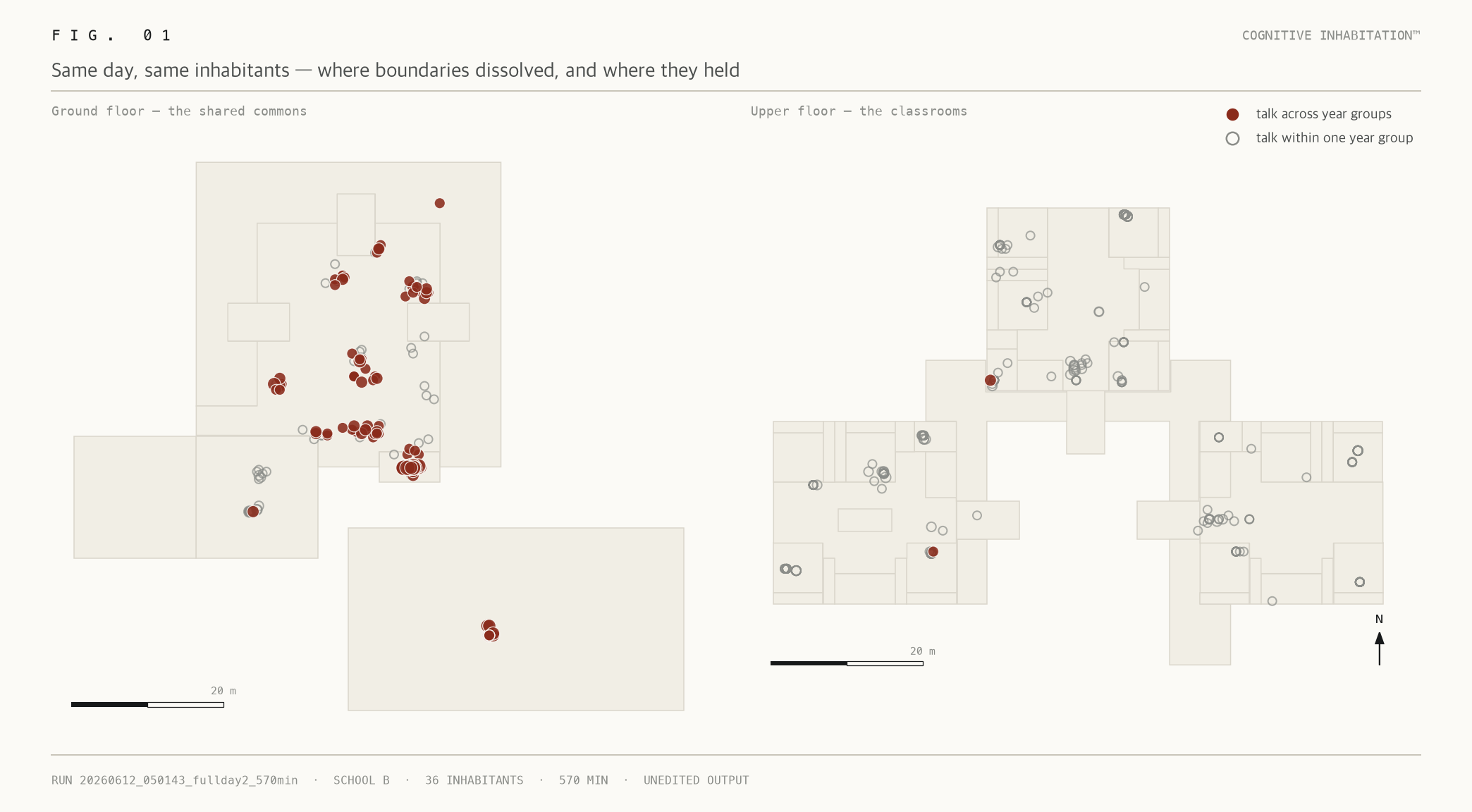
Every conversation of one day, placed where it happened. Downstairs, in the commons, most talk crosses year groups. Upstairs, on the same day with the same children, almost none of it does.
A design is a chain of decisions that cannot be taken back, and each is defended with intuition. We place cognitive agents inside the BIM model and let them live there — in workplaces, schools, hospitals, mixed-use buildings, wherever several groups have to share one floor.
Cognitive agents that perceive, remember and form impressions of a place
No scripts or fixed routines — each acts on its own disposition, uninterrupted
Derived from the architect's own BIM (IFC) model
Unedited simulation output, replayable in full
An irreversible decision is taken every week of a design. Today it is defended with precedent and intuition. Cognitive Inhabitation puts a measurement in that place — the social life each alternative would invite, read before ground is broken.
A wind tunnel for human behaviour.
The BIM (IFC) model becomes the world agents inhabit — walls, rooms, stairs, sightlines — without redrawing.
Cognitive agents with memory, reflection and planning live there for days. No scripts — the behaviour emerges.
Every gathering and every encounter is logged and replayable — a measurable property of the design, before ground is broken.
The reading is at its most useful where several groups have to share one building — a workplace, a school, a hospital, a mixed-use complex. What we measure is not headcount but who ends up meeting whom, and where.
What differs is where people gather, where they talk, where they linger. Nothing here is choreographed. The two panels are separate runs; each source and engine generation is printed under the frame.

Every conversation of one day, placed where it happened. Downstairs, in the commons, most talk crosses year groups. Upstairs, on the same day with the same children, almost none of it does.

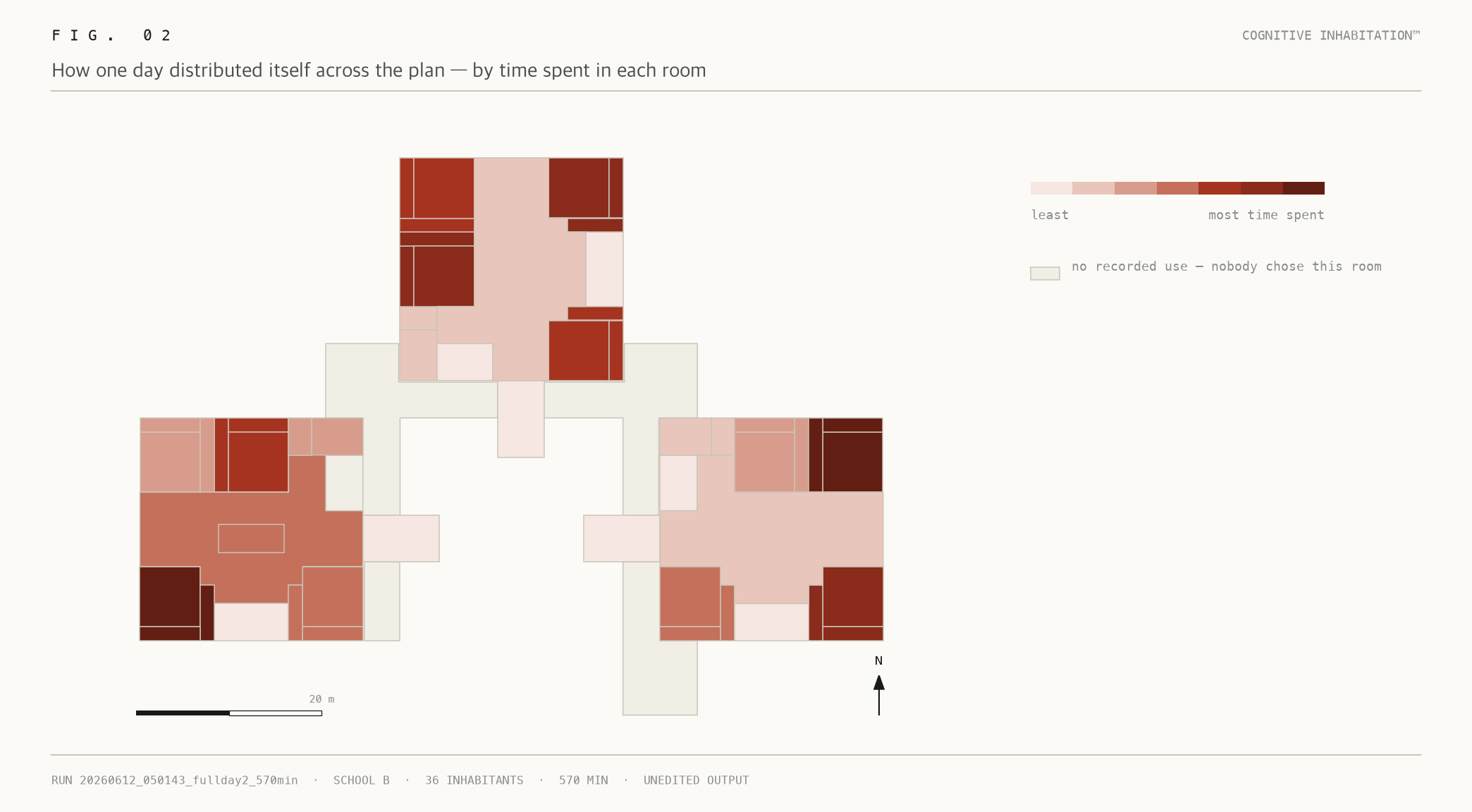
The classroom floor shaded by how long each room was actually occupied. Rooms left uncoloured recorded no use at all across the whole day.
Four conversations from one day on the classroom floor, each placed on the plan where it happened. Under them, faintly, is the day's movement — routed on the walkable grid, so no line crosses a wall. The dialogue is what the agents actually said to one another: unedited output, translated only.
A run can also be laid back over the plan — where the talking happened, who stayed and for how long, which routes wore in. See the figures on Research →
The evidence is open. Every replay on this site is unedited simulation output, and the concept, the method and the verification results are published as papers.
Paper 1 is submitted to the Architectural Institute of Korea 2026 Autumn Conference. The abstract and the three-seed research data are on the paper page; the full text follows the proceedings.
Every result is checked in three passes — ranking, distribution, then response to a controlled intervention — before it is called a finding.
You do not have to take the verification on trust: the replays on this site are the runs the findings were read from. More on Method →